Bulk Screen Printing and Embroidery Manufacturers: What They Actually Are (and How to Find One)
Most companies searching for a bulk screen printing manufacturer or bulk embroidery manufacturer end up talking to a distributor. Here's how to tell the difference, what a real manufacturer relationship looks like, and what to ask before you commit.
Search for “bulk screen printing manufacturer” or “bulk embroidery manufacturer” and most results are promotional products distributors — companies that buy from manufacturers and resell to you. A few are actual manufacturers. Knowing the difference before you start quoting saves money and time.
What “Bulk” Actually Means
“Bulk” means different things at different scales:
- 500–5,000 units — A local shop or regional decorator. Setup costs are manageable, and you don’t need a direct manufacturer relationship.
- 10,000–50,000 units — A middle range where larger shops and smaller manufacturers both compete. Pricing varies widely.
- 100,000+ units — Manufacturer territory. Setup costs are a rounding error at this volume. A distributor’s 40–60% margin becomes a six-figure line item with no corresponding benefit.
A true bulk manufacturer is calibrated for the top of that range. Their equipment, minimums, and production management are built for continuous large-run output — not a regional shop that occasionally takes a big order.
Manufacturers vs. Distributors
Manufacturers own presses, embroidery machines, and production facilities. When you place an order, it goes directly to their production floor.
Distributors own sales operations — reps, account managers, sometimes design staff — but no production equipment. They place your order with a manufacturer and mark it up 40–60%.
Distributors aren’t the enemy — they add real value for smaller buyers who need sourcing help and order coordination. At 100,000+ units, you don’t need that help, and you’re paying a premium for it anyway.
The harder problem: distributors don’t always present as distributors. Phrases like “our production team” or “we manufacture your order” often mean “the factory we outsource to.” Technically accurate, practically misleading.
For more on how the markup works, see how much a promo company marks up screen printing and the direct vs. distributor buyers’ guide.
How to Tell if You’re Talking to a Manufacturer
“Do you own the production equipment?” The cleanest question. A manufacturer says yes immediately. A distributor deflects: “we have a network of vetted production partners” or “we work with the best factories.” That’s a distributor answer.
Ask for a facility tour. Real manufacturers have facilities worth showing — automated press lines, multi-head embroidery machines, ink labs, QC stations. If they won’t show you the floor, that’s the answer.
Check their minimum order. No minimum or a 24-piece minimum means you’re not talking to a bulk manufacturer. Manufacturers who run high-volume production have minimums that reflect their economics — typically tens of thousands of units.
Ask who handles pre-press and digitizing. A bulk screen printing manufacturer does color separation, screen making, and ink mixing in-house. A bulk embroidery manufacturer digitizes in-house. These are technical production roles. Distributors don’t have them — they forward your files to the factory.
What a Bulk Screen Printing Manufacturer Looks Like
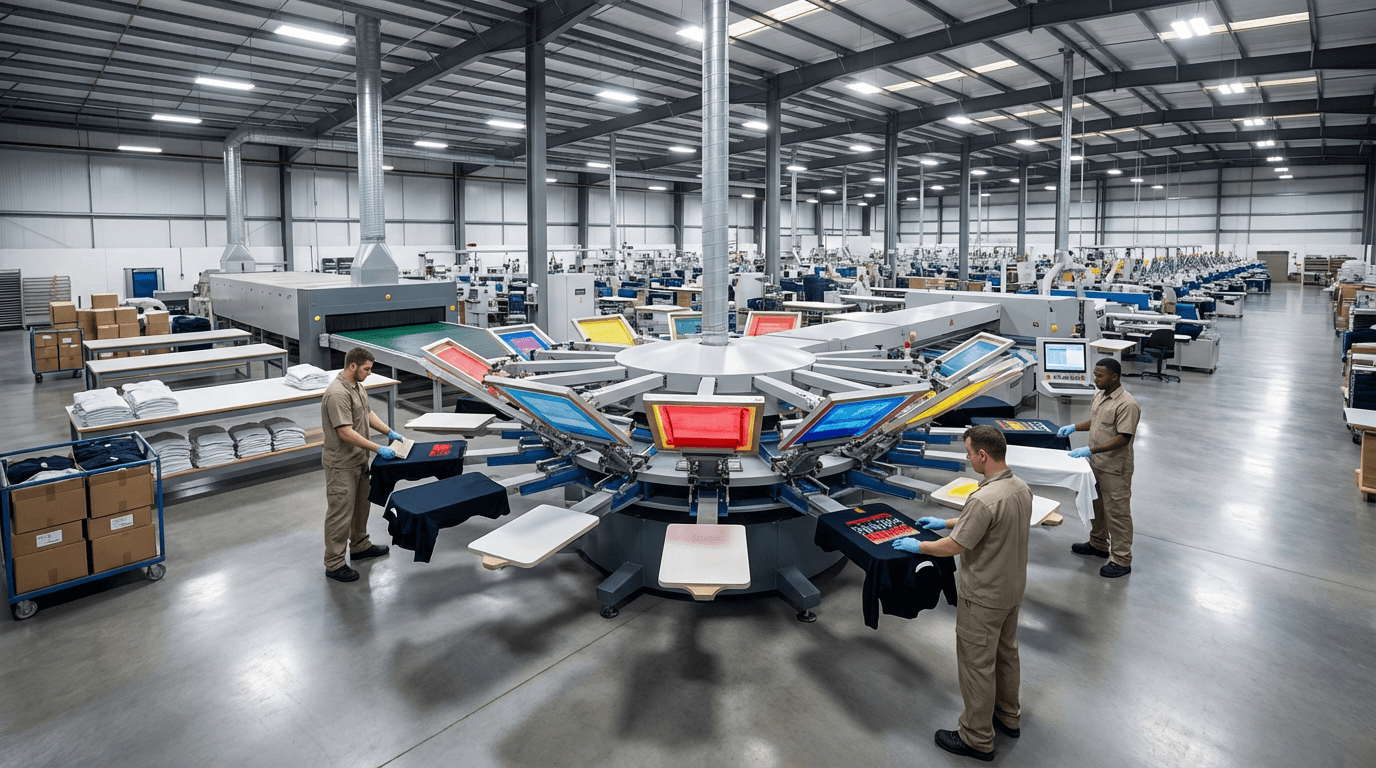
Industrial automatic press lines — manufacturers like ROQ build the oval and carousel presses that serious high-volume decorators run. Ink labs with spectrophotometer-based Pantone matching. Dryer systems calibrated to specific ink and fabric combinations. The operation is built for continuous production — not adapted from equipment designed for 500-piece jobs.
At 100,000 units, the variables that matter:
- Color consistency — Unit 1 and unit 100,000 are visually identical. This requires precise ink mixing and automated press controls that reduce operator variability.
- Registration — On multi-color designs, every screen hits the same position on every garment. Automatic presses with registration systems are what make this possible at scale.
- Throughput — A bulk manufacturer commits to and hits timelines because their capacity is designed for this kind of run. They’re not juggling your 100,000-unit order alongside fifty 500-piece jobs.
See what a 100,000-unit screen print order actually costs and our screen printing capabilities.
What a Bulk Embroidery Manufacturer Looks Like
Banks of multi-head embroidery machines — 6, 12, or more heads per machine, often dozens of machines running simultaneously. At 100,000 units, the manufacturer needs both the machine capacity and the production management to maintain consistent quality across the run.
What separates a genuine bulk embroidery manufacturer:
- In-house digitizing — Converting artwork into a machine-readable stitch file is a skilled technical role. A bulk manufacturer does this in-house, optimized for their specific machines. Distributors have no digitizing capability — they forward your file to the factory.
- Thread management — At 100,000 units, dye lot consistency across thread supply matters. A manufacturer manages this; most distributors don’t even know it’s a variable.
- Backing specification — The stabilizer (backing material) prevents distortion on stretch fabrics, performance materials, and structured headwear. It’s a technical production decision, not a footnote. Manufacturers make it deliberately; distributors typically don’t make it at all.
See embroidery stitch count explained and our embroidery capabilities.
When You Need Both
Most large corporate, franchise, and retail programs use both methods on different garment types within the same program.
The rule of thumb: screen printing for t-shirts, bags, and event merchandise — anything where cost-per-unit is the driver. Embroidery for polos, dress shirts, headwear, and fleece — anything where the decoration needs to communicate quality.
A franchise system outfitting 10,000 employees might need screen-printed tees for warehouse staff, embroidered polos for customer-facing teams, and embroidered caps for managers — all under the same brand, all at volume.
A manufacturer who runs both in-house means one PO, one point of contact, and one consistent quality standard. Two separate vendors for the same brand program is a coordination headache that gets worse at scale.
See screen printing vs. embroidery for large orders.
Questions to Ask Before You Commit
About the operation:
- Do you own your production equipment?
- What is your minimum order quantity?
- What is your production capacity for a run of this size?
- Can I tour your facility?
About your specific order:
- Have you run this fabric and garment type before at this volume?
- How do you control dye migration on polyester? (Screen printing)
- What stabilizer do you use for this fabric type? (Embroidery)
- What does your pre-production sample process look like?
About accountability:
- Who is my direct contact in production — not sales?
- How do you handle out-of-spec work?
- What happens if production runs behind schedule?
For a full vetting framework, see how to evaluate a screen printer before a large order.
Merch Factory Direct is a US-based bulk screen printing and embroidery manufacturer for orders of 100,000+ units. We own our production equipment, handle pre-press and digitizing in-house, and work directly with buyers — no distributor between you and the press. See our screen printing and embroidery capabilities, or contact us to discuss your program.