Private Label Apparel Manufacturing: A Complete Guide for Brands
Private label apparel manufacturing lets brands create custom clothing without designing from scratch. Learn how factory-direct production works, minimums, and cost structures.
Private label apparel manufacturing has become the backbone of countless brand strategies — from emerging direct-to-consumer labels to established retailers building exclusive product lines. Instead of stocking generic blank garments and decorating them, brands work directly with manufacturers to produce apparel that carries their own identity, from the ground up.
This guide covers what private label production actually involves, who it’s for, and how to evaluate a manufacturer for your program.
What Private Label Apparel Manufacturing Actually Is
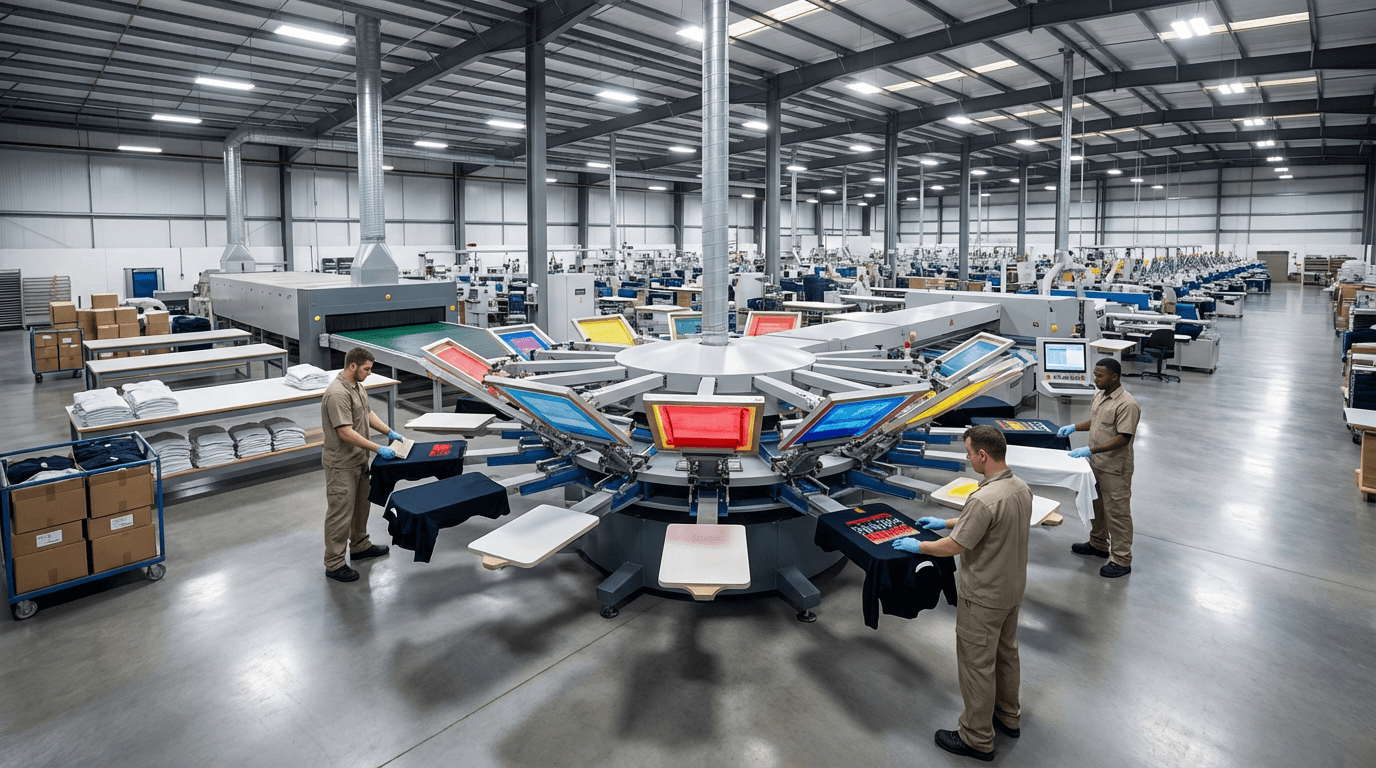
Private label apparel manufacturing means hiring a production facility to create garments under your brand name — with your labels, your tags, your specifications. The manufacturer handles fabric sourcing, cutting, sewing, and decoration. You receive finished goods ready for sale or distribution.
This is different from:
- Buying blank garments and decorating them yourself — you’re not the manufacturer, just the decorator.
- White label / stock blanks — generic products anyone can buy; not unique to your brand.
- Custom cut-and-sew from scratch — full fashion manufacturing with custom pattern development; typically higher minimums and longer lead times.
Private label sits in the middle: you specify garment details (fabric, weight, color, fit), and the manufacturer produces them with your branding. It’s the fastest path to branded apparel without the complexity of fashion manufacturing.
How Private Label Manufacturing Works
The typical flow:
1. Product specification. You choose the garment style, fabric blend, weight, and colors. Most manufacturers offer established blank styles (t-shirts, hoodies, polos) that they’ve refined for production efficiency. You select from their lineup rather than designing from zero.
2. Brand customization. You provide your logo, designs, or artwork for decoration. The manufacturer handles screen printing, embroidery, or other decoration methods. You specify label content, hang tags, and packaging.
3. Sample development. The manufacturer produces a sample for approval. This is critical — fabric colors can render differently than digital approximations, and construction details need physical verification.
4. Production run. Once samples are approved, production begins. Lead times vary by manufacturer and order size; 8–16 weeks is typical for private label apparel.
5. Fulfillment. Finished goods ship to your warehouse, distribution center, or directly to customers.
Private Label vs. Other Production Models
| Factor | Private Label | White Label | Custom Cut-and-Sew |
|---|---|---|---|
| Customization | High (your specs) | Low (stock styles) | Full custom |
| MOQ | 10,000-100,000+ | 24-500 | 500-5,000+ |
| Lead time | 8-16 weeks | 1-4 weeks | 12-24 weeks |
| Design input | Moderate | Minimal | Extensive |
| Cost per unit | Competitive at scale | Low | Higher |
The right model depends on your volume, timeline, and how differentiated you need your product to be.
Minimum Order Quantities Explained
Private label manufacturing minimums exist for the same reason wholesale screen printing minimums exist: production setup costs. Cutting, sewing, and finishing a run of 500 garments has nearly the same setup overhead as 50,000 — fabric must be cut in batches, machines must be configured, QC must be performed on each size run.
Typical minimums:
- 10,000 units — Entry-level private label programs, usually across 2-3 styles/colors.
- 25,000-50,000 units — Mid-tier programs with more variety.
- 100,000+ units — Full-scale production programs with multiple style categories.
These minimums are typically per style, per color. A 50,000-unit program might mean 10,000 units each of a t-shirt, a hoodie, and a polo — in your brand’s colors.
Cost Structure at Scale
Private label pricing at scale is competitive with or below equivalent blank-plus-decorate costs. Why? Because you’re buying the complete garment, not separately sourcing blanks and paying for decoration separately.
Key cost factors:
- Fabric — Cotton, polyester, blends, and performance fabrics each have different price points. At 100,000 units, fabric cost is the primary driver.
- Decoration — Screen printing and embroidery are the standard methods. Each has its own pricing structure (per color for screen, per stitch for embroidery).
- Labels and tags — Custom woven labels, size tags, and hang tags add a small per-unit cost but are essential for brand identity.
- Packaging — Poly bags, retail packaging, and custom boxing all add to per-unit cost.
At 100,000+ units, a private label t-shirt program often lands in the $4–$8 per unit range (including blank, decoration, and labeling), depending on fabric and decoration complexity.
What You Need to Provide
To work with a private label manufacturer, come prepared with:
- Brand identity assets — Logo files (vector), color codes (Pantone), brand guidelines.
- Garment specifications — Style, fabric, weight, fit preferences. Most manufacturers have preferred blanks they can produce efficiently.
- Decoration artwork — Print-ready files or help from the manufacturer’s design team.
- Volume forecast — Honest estimates help manufacturers plan capacity and pricing.
Finding the Right Private Label Manufacturer
Not all manufacturers are created equal. The key differentiators:
Production capabilities. Can they do both cut-and-sew (for woven garments like shirts and shorts) and knit goods (t-shirts, fleece)? Some specialize in one or the other.
Decoration in-house. If they screen print and embroider in-house, you deal with one vendor. If they outsource decoration, you add a middleman.
Lead time track record. Ask for their actual lead time on the last three comparable orders. Promised lead times and actual lead times differ.
Sample process. A manufacturer who rushes past samples is a red flag. Sample approval is where mistakes get caught before they’re replicated 50,000 times.
References. Ask for brands they currently produce for. Call them. Ask about quality consistency, communication, and on-time delivery.
Is Private Label Right for Your Brand?
Private label makes sense when:
- You have enough volume to meet minimums (10,000+ units annually per category)
- Brand differentiation matters — you want product that can’t be bought elsewhere
- You’re building a long-term apparel program, not a one-time event order
- You want to control the full product experience, from fabric to packaging
Private label may not be the right fit when:
- You’re testing a product idea with a small initial run
- You need fulfillment in weeks, not months
- Your volume is below 10,000 units per year in a category
For smaller volumes, screen printing on quality blanks is still the most cost-effective path.
Merch Factory Direct offers private label apparel manufacturing for brands at scale. Factory-direct production means no distributor markup — you work directly with the manufacturer producing your apparel. Our minimums start at 100,000+ units for serious private label programs. See our capabilities or contact us to discuss your private label program.